
Stranger Than That
Dan Coxon: Talking about pushing the form and the element of surprise

Welcome to STRANGE LITTLE STORIES, the place where writers can share real-life incidents that haunt them; memorable events, peculiar occurrences, uneasy encounters, the kind of thing writers usually transform into stories. Here, we give writers a chance to focus on the raw material of real life, to discuss what makes these memories so indelible, and examine the mysterious relationship between truth and fiction.
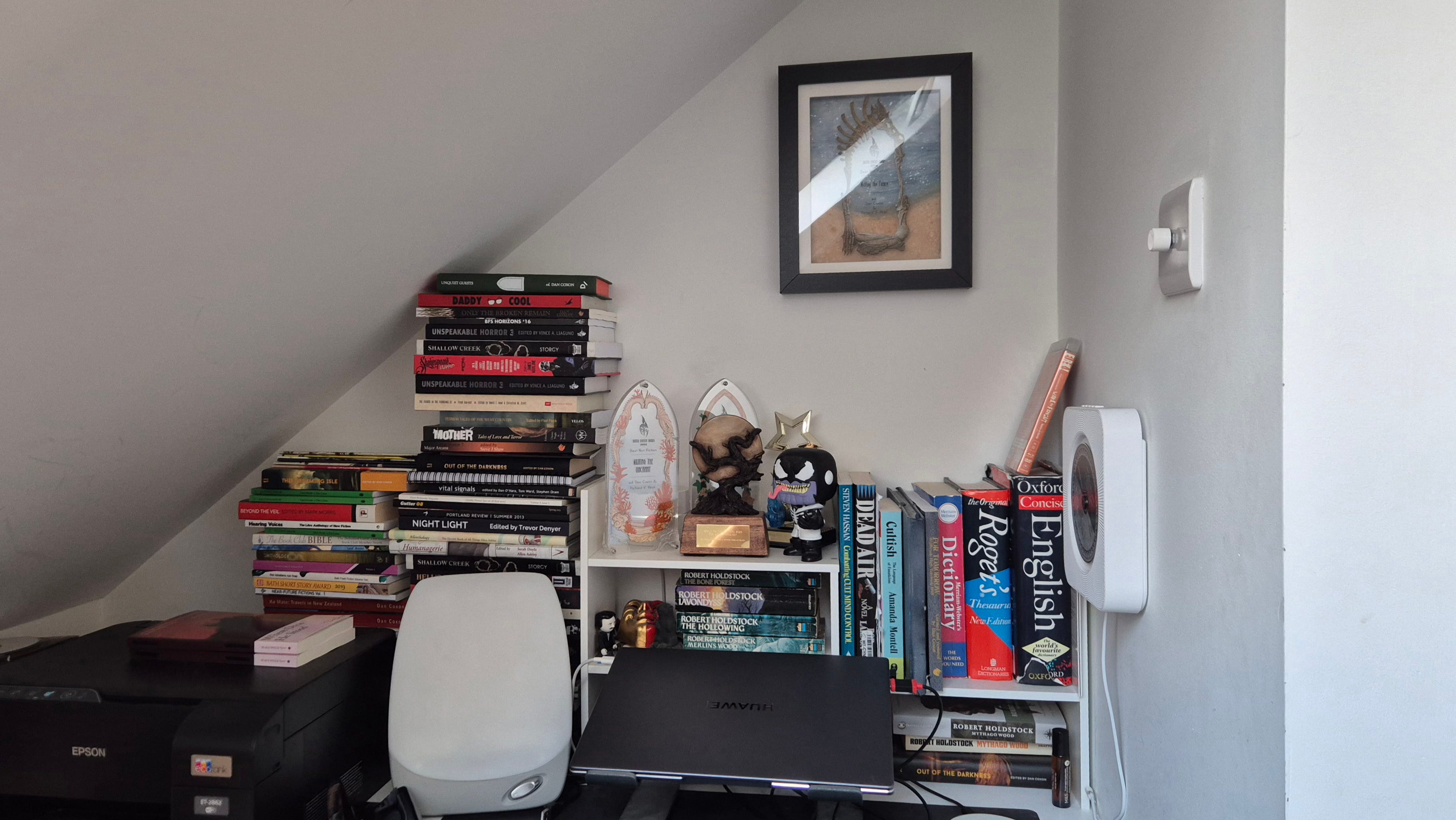
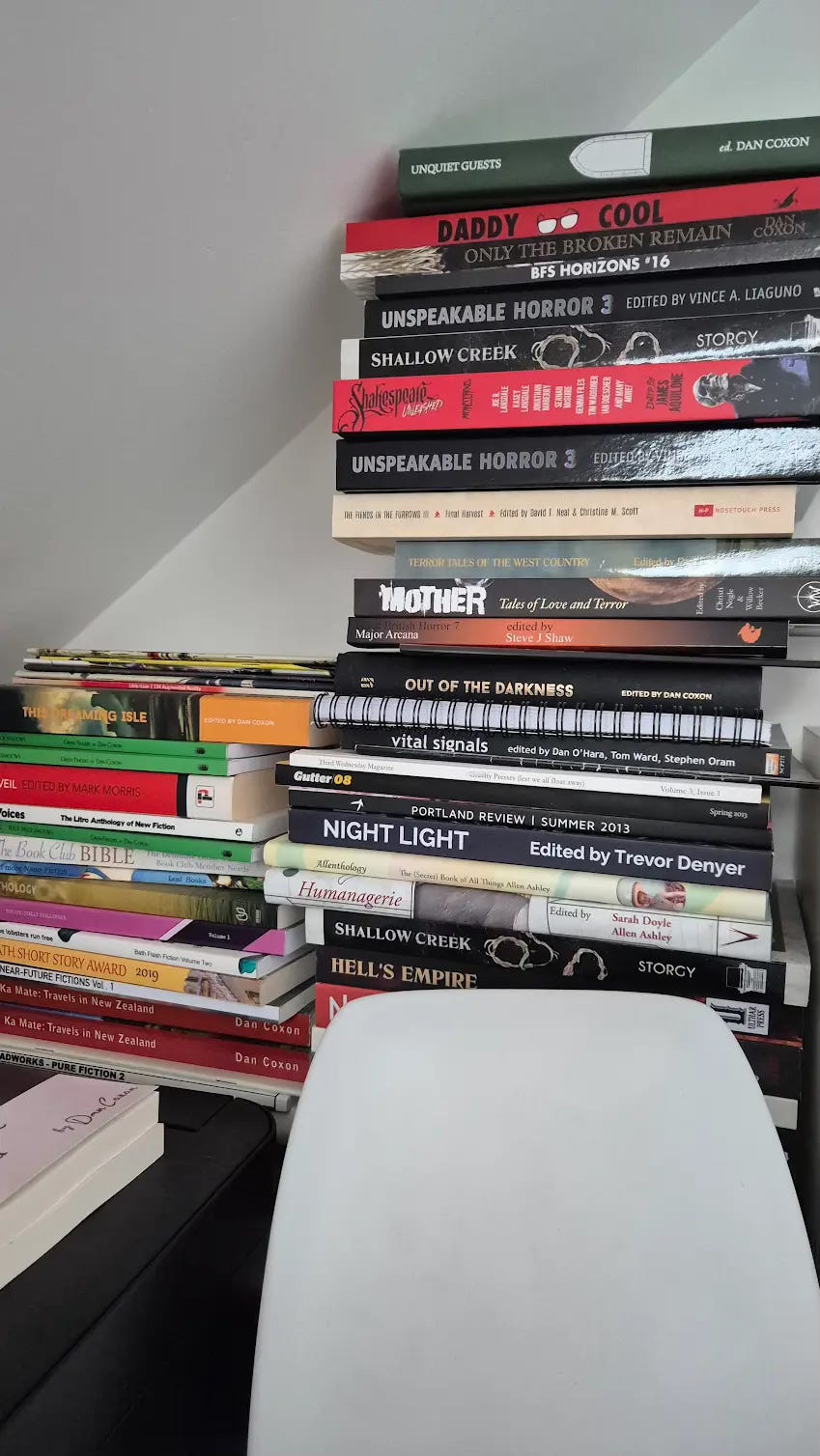
This time, it’s my pleasure to welcome Dan Coxon, fiction writer, non-fiction writer and anthologist extraordinaire. Dan is the winner of two British Fantasy Awards for the anthologies Writing the Uncanny and Writing the Future, both co-edited with Richard V. Hirst, and his anthology Heartwood: A Mythago Wood Anthology won the World Fantasy Award. As a fiction writer, his collection Only the Broken Remain was published by Black Shuck Books, and his new collection of modern folk horror stories, Come Sing For the Harrowing is being reissued this year by Clash Books. Author Brian Evenson had this to say: “Coxon is a writer who, flitting on the edge of horror as a genre, extends and complicates the domains of folk horror and the weird in important ways.”
In this story, Dan focuses on how even the simplest inanimate objects can take on a powerful feeling of the uncanny and cause us to question what we sometimes mistakenly refer to as “reality”.
Lost and Found
by Dan Coxon
I bought the ring in the summer of 1996.
I was twenty-one at the time, about to enter the final year of my university degree. Over the summer break I’d decided that I needed to reinvent myself – make myself seem edgier, more exciting.
For some reason, I’d settled upon a pinky ring. I’d seen someone wear one in a recent film (maybe Interview with the Vampire?), and thought it looked rakish and piratical. Then I’d spent a week working with my dad in the Czech Republic, in Mariánské Lásnĕ, sometimes known as Marienbad. One of his co-workers had sported a similar ring, a similar look. It was badass, I thought. It would make me badass too.
Looking back, I had larger issues with my image than a lack of finger jewellery. But still, the ring was thing I settled upon.
I’m not sure where I bought it. Today, I would probably browse online, pick out something exotic – and, yes, piratical – from Etsy or eBay. But those weren’t options at the time. I have a vague recollection of travelling on the 281 bus to Kingston specifically to buy it, buoyed by the anticipation. I purchased it at a small, privately owned jeweller’s, I think. I don’t know. When I last searched for it, the shop was no longer where I thought it should be.
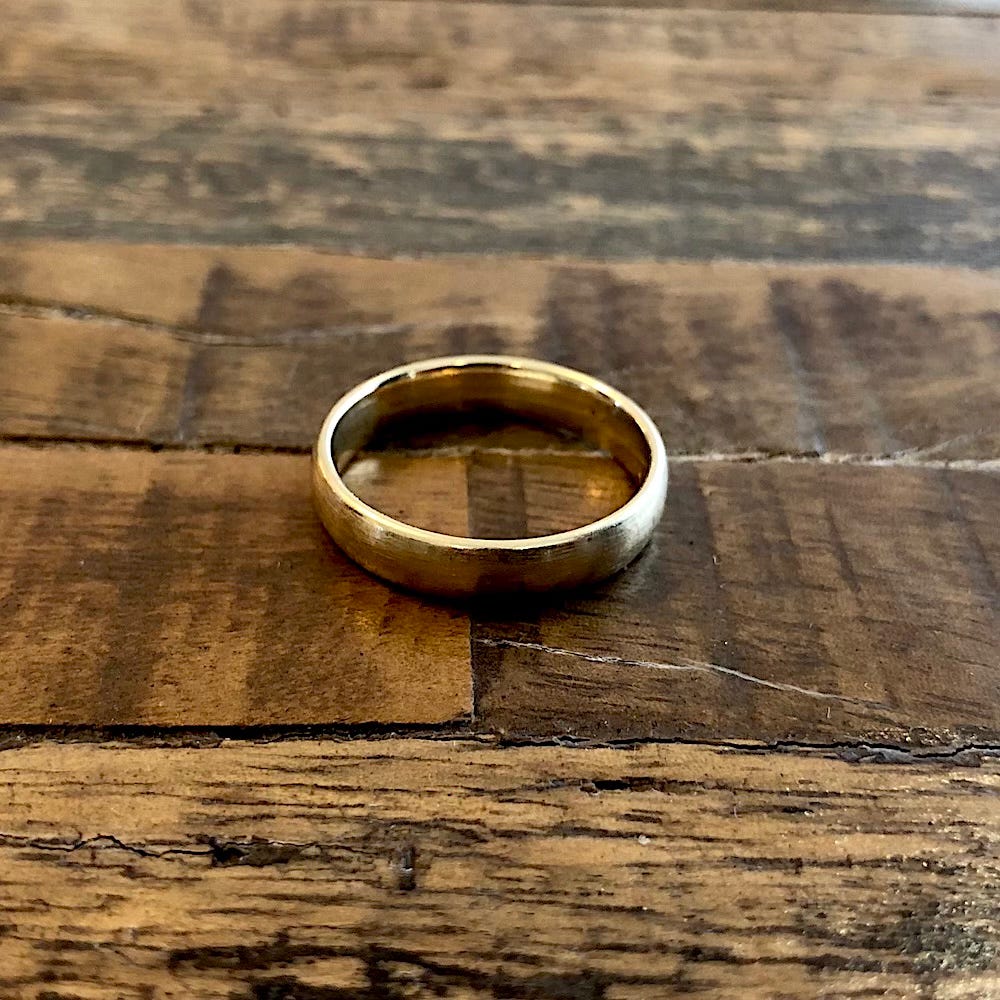
The ring I settled upon was a simple gold band, only a couple of millimetres thick and unadorned. It was small enough to slip comfortably onto my little finger. I liked the simplicity and elegance of it. I wore it on the last finger of my right hand, and when I returned to university in September it received a few comments, mostly positive. More than that, it gave me a confidence I hadn’t had before.
Then I lost it.
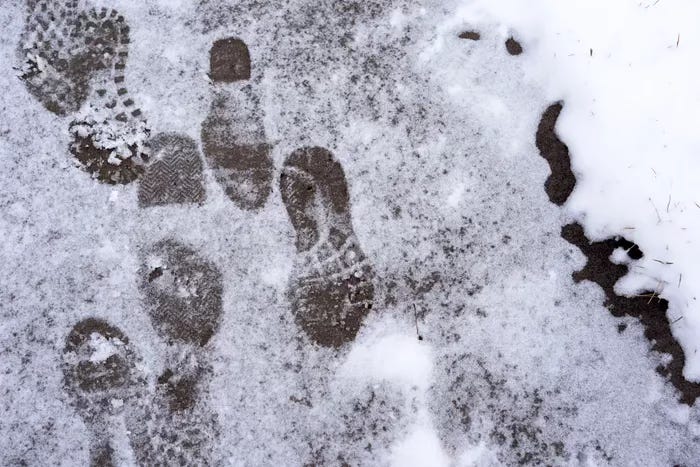
We had an early snow that year, and before we broke up for Christmas there was a thick blanket on the ground, several inches deep. We were still young enough to see snow as an opportunity for play rather than an obstacle, and I’m sure we had more than a few snowball fights on the way home from the pub, barely sober enough to stand on the compacted ice.
I didn’t wear gloves at the time (not rakish enough), and the cold snap must have caused my fingers to shrink. When I got home one night from visiting my girlfriend, the ring was gone.
And that, I thought, was that. It had cost about £30, a not inconsequential sum for a student in 1996, so I didn’t have the means to replace it. I was gutted. Without it I felt like I’d returned to the old me, plain and uninteresting. My brief flirtation with glamour had come to an abrupt end.
It was a couple of days later that my girlfriend’s flatmate mentioned she’d been knocking on all the doors in their apartment block. She wasn’t sure what to do next, she said. She’d found someone’s wedding ring in the snow, and she hated the idea of anybody having lost something so emotionally significant. When she opened her hand, my pinky ring was nestled in her palm. It seemed miraculous that it should have found its way back to me, and I suspect I bought her a pint or two to thank her. Disaster had been averted.

Then, a few months later, I lost it again. It reappeared in my girlfriend’s car this time, under the passenger-side seat.
Then I lost it again. And again.
And again.
I can’t count the number of times I’ve lost that ring over the years. That in itself isn’t unusual – I lose many things – but the ring has always come back to me, without fail. Often I haven’t even bothered looking for it, secure in the knowledge that it will somehow return. It might turn up in a pocket, or a drawer; on more than one occasion, it was found in a public area again by someone I knew, and handed back to me.
I was still wearing it when I started my first job, working as a bookseller at Edinburgh Airport. A large part of the job was unpacking deliveries and taking the cardboard boxes out to the recycling compactor opposite the terminal building. Once, I very specifically remember looking down after I’d thrown the recycling into the compactor and noticing the ring was gone. There was no way to get into the compactor to search for it, but I opened the steel door again anyway, just in case.
There it was, sitting inside the first open box I saw, atop a bundle of loose papers and packing materials.
At some point, I stopped wearing the ring. I think we were living in America at the time, and more and more it had started to seem a rather childish affectation, an attempt to make myself more interesting that felt increasingly shallow and poorly judged. I think I dropped it into a drawer somewhere, alongside unused cufflinks and forgotten souvenirs. In 2013 we moved back to the UK.
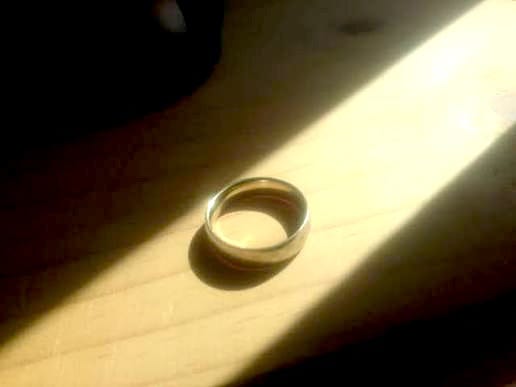
It’s still here, though, sitting in a drawer in a new cabinet that we bought when we moved into our current house, five or six years ago. I have no recollection of putting it there, or even bringing it back from America with us. I certainly haven’t worn it in over fifteen years. It’s definitely the same ring, though, scuffed and dented, knocked slightly flat from the time when I shut my hand in car door and the ring saved my little finger from being crushed.
I’d throw it away, but I have no doubt that it would find its way back to me, somehow. I’ve accepted that now. And maybe I’m okay with it, and the memories attached to it – of a summer in Marienbad, a winter in snow; of adventures overseas and career milestones and friends lost and found. A memento of the rakish, piratical me that never was.
Talking Truth and Fiction With Dan Coxon
DS: Thanks again for this great story. I love it whenever a story stretches the boundaries for what a strange story is, and you’ve certainly done that here. When I asked you to contribute a strange-but-true story of your own, about how long did it take you to come up with this one?
DC: I have to admit, it’s something I’ve thought about before. When we did bookstore events for Unquiet Guests, my haunted house anthology, we were often asked for our own encounters with ghosts or the supernatural... and I had nothing. I’m essentially a sceptic who would dearly love ghosts to exist, but I can’t say I’ve seen anything to suggest they do. So I spent several occasions racking my brain to see what I could come up with, anything strange or unexplained from my past... and this was it. It’s not a ghost story, but somehow it feels stranger than that, at least to me. I think because it falls outside of traditional narratives, there’s no explanation at the end - it just happened to me, and I have no idea how or why.
DS: I love what you say: “It’s not a ghost story, but it feels stranger than that.” Ghost stories can be wonderful, but it sometimes feels a little too easy to slip into the familiar, so it becomes more difficult to be surprised, and to surprise the reader––whereas a story like yours feels (oddly) both unfamiliar (as the subject of a weird tale) and familiar (as a common human experience; i.e. losing things). Call me crazy, but your story actually made me think of the beginning of Tom Stoppard’s ‘Rosencrantz and Guildenstern Are Dead’ , where Guildenstern keeps flipping the coin and it keeps coming up heads seventy times in a row. It’s that whole ’this-can’t-be-happening-but-it-is’ vibe.
DC: It’s certainly something I aim for in general terms in some of my fiction, although it’s never come out quite like this. Even when I’m working in quite familiar subgenres - ghost stories, folk horror - I try to push the form into new shapes, so they still retain at least some of the element of surprise. And I do like stories that feel both familiar and unfamiliar. That is, after all, the essence of the Uncanny.
DC: I find the concept that we’ve somehow misunderstood the world quite appealing. That these rules and structures we have put in place aren’t quite as solid and irrefutable as we’d like to pretend. It feels like a particularly relevant mode of writing at the moment, with the world around us feeling so odd and inexplicable at times - it’s all built on shifting sands. All the crazy theories about us living in a simulation are drawn from these phenomena, I think, only they take the broken rules as proof of its fabrication; personally, I think the rules were never rigid in the first place.
DS: I find that concept (that’s “we’ve somehow misunderstood the world” and that the rules and structures we live by not being irrefutable) quite appealing too. What’s interesting is how some people find that idea terrifying, while others find it liberating. It’s always seemed to me that weird fiction (or the uncanny) takes both of those responses into account, while lots of traditional horror stops with the first one.
Other than this particular experience with the ring, how often would you say that you draw on your own real life experiences for your fiction? Do you tend to go through a particular process for that?
DC: Most of what I’ve written doesn’t draw directly from experience. I often use locations that I’ve visited - I’m fairly well travelled, which means I have a good ‘library’ of places to draw upon - but most of the plots and characters are entirely imaginary. I’m sure elements of my own experiences bleed through, as we all inevitably root things in our lived experience, but on the whole I don’t draw upon that explicitly.
That said, my recent chapbook with Salo Press, Never Land, was an attempt to combine weird/uncanny horror with elements of autofiction. Some of the situations in that are real, and even a couple of the characters (although they tend to be composites of more than one person). And I’m there at the centre of the story as the narrator. It involves a ‘found’ story, which is an actual story I wrote back in the late nineties. It was interesting to play around with autofiction in an uncanny way, although I do worry that readers who don’t know me will think it’s all imagined!
DS: That sounds really interesting. I’m embarrassed to confess, I wasn’t familiar with the term “autofiction”, but I believe some of my favorite books must be autofiction––‘So Long, See You Tomorrow’ by William Maxwell, for instance, is a tremendously powerful and moving example of hopping back and forth from autobiographical to fictional storytelling (and back again).
Yours, Never Land, sounds fascinating. (I just stopped typing this to order it!) It’s interesting to see you say that you worry that readers who don’t know you will think it’s all imagined––most other writers worry that people who know them will think that the wildest imaginary bits are true!
DS: Can you say what it was that inspired you to try your hand at writing autofiction (after pretty resolutely not doing that for a while)? Once you started writing Never Land, was there anything that surprised or even delighted you about the process?
DC: To be honest, I was never avoiding autofiction, it had just never occurred to me to try it - or that it might be something you could combine with horror. Paul Tremblay does it sometimes in his short fiction, which may have been where I first saw it. He wasn’t a direct influence, though. I tend to like trying new things in my writing, new techniques or modes, mainly to keep it interesting and prevent myself from getting bored (I’ve played around with cut-up techniques in the past few years, as well as writing a couple of epistolary stories). It just felt like an interesting new thing to try.
I think the initial kernel was sown when I found my old story, ‘Dark Heart’. It seemed pretty cool that I was still writing in a similar vein thirty years on, and I started thinking about how I could use it in a new piece, or at least be influenced by it. Without giving too much away, Never Land plays with the idea that the piece somehow belongs to me, but also doesn’t. I’ve written a couple of collaborative stories in the past, so in many ways the experience was like that, only the person I was collaborating with was myself, thirty years ago. There were also some odd connections with a couple of real-life coincidences, until it all started to tie itself neatly together - then I couldn’t not write it.
DS: You’re right––it does feel good to shake up one’s writing now and then with new techniques. And yes, cut-ups and collages can be a fantastic, mind-opening thing to try. I also like what you say about collaborating with your (younger) self. Encountering your former self in your writing can also be quite mind-opening (or at least eye-opening). ;-)
Dan, thank you so much for your strange little story, and for this conversation. I’ve really enjoyed it!
DC: Thanks David! And thanks for the excellent questions/discussion. Hope it was interesting for you too! And thank you again for inviting me.
If you’re a reader or a writer (or both) with thoughts about what you’ve just read here, or your own experiences exploring the tricky boundaries between real life and fiction, I’d love to hear about them.
Thanks to Dan Coxon for joining us at STRANGE LITTLE STORIES. If you’d like to learn more about Dan and his writing, you can visit his website.
And, just another reminder that my new collection These Things That Walk Behind Mefrom Lethe Press is now available from Amazon or direct from the publisher. Hope you’ll check it out.
Thanks for reading STRANGE LITTLE STORIES. See you next time.